
The company's decision may impact new projects, which are likely to get delayed, said sources in the know. Among the IT players that work with Macy's are Accenture, Cognizant, Tata Consultancy Services (TCS), and Infosys. Macy's is among the top 5-10 clients of these companies.

Australian national airline Qantas on Wednesday announced slew of cost-cutting measures, including job reductions, retirement of older aircraft and a reduction in domestic and international flights.

The seasonally adjusted India Services Business Activity Index rose from 45.4 in July to 56.7 in August, as the reopening of several establishments and increased consumer footfall boosted sales. The services sector witnessed the first expansion in output in four months and a rebound in business confidence.

You finally end up with an army of midgets led by midgets, notes Sandeep Goyal.

'In India, the impact will be less than 1% of employee headcount.'

Most large companies have curbed their hiring plans in 2018-19 because they continue to invest in digital technologies.

The sector will see a minimum of 3-5 per cent of the weight being shed in almost every IT company - particularly the big 20 - because of Covid and not performance-related issues.

Unisys said it is exploring a wide range of cost-reduction options and that actions currently underway are expected to reduce its annual cost structure by more than $225 million. The cost-reduction actions -- led by new Unisys chairman and CEO Ed Coleman -- are part of an overall programme to simplify the company's business structure, concentrate its resources more effectively and drive improved market success and profitability, Unisys added.

After a recent fall in profit, Masayoshi Son of SoftBank announced that the Japanese tech investor will look at dramatic cost-cutting. Before he does that, investments in India for calendar year 2022 (CY22) will fall radically, observed sources in the know. Last year, the company had invested around $3.2-3.5 billion in the Indian start-up ecosystem - almost 10 per cent of the total investment the sector received. For CY22, the investments may not even touch $1 billion.

The move comes close on the heels of rival Credit Suisse Group announcing about 2,000 job cuts last month.
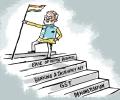
Three-quarters into the 10 years that Mr Modi had sought for transforming India, the 'output' numbers look impressive, but the key 'outcome' numbers don't show up much, if at all, observes T N Ninan.

Uber on Tuesday said it is laying off about 600 employees in India -- about a quarter of its staff in the country -- as business has taken a major hit amid the COVID-19 pandemic. The development comes days after rival Ola had announced laying off 1,400 people from its rides, financial services and food business.

The company, a joint venture between Finnish cell phone maker Nokia and German conglomerate Siemens AG, is planning to bring down its annual operating expenses and production overheads by 500 million euros by the end of 2011.

The company has raised its revenue outlook for FY2019-20 in constant currency to 10-10.5 per cent, from its topline guidance of 9-10 per cent given in October.

The carrier is implementing a number of measures.

With automation taking place at a much faster pace across industries especially in the tech space, domestic software firms that employee over 16 million are set to slash headcounts by a massive 3 million by 2022, which will help them save a whopping $100 billion mostly in salaries annually, says a report. The domestic IT sector employs around 16 million, of them around 9 million are employed in low-skilled services and BPO roles, according to Nasscom. Of these 9 million low-skilled services and BPO roles, 30 per cent or around 3 million will be lost by 2022, principally driven by the impact of robot process automation or RPA. Roughly 0.7 million roles are expected to be replaced by RPA alone and the rest due to other technological upgrades and upskilling by the domestic IT players, while it the RPA will have the worst impact in the US with a loss of almost 1 million jobs, according to a Bank of America report on Wednesday.

While Tech Mahindra's Gurnani earned Rs 146 crore in 2017-18, his actual gross salary component was Rs 2.77 crore. Wipro's Neemuchwala, on the other hand, took home Rs 18.23 crore

The company stated that it was taking steps for cost rationalisation across all businesses to maintain liquidity and due to a prolonged slowdown it had to take a few tough measures.
Sector experts say rising pressure on margins owing to price discounts on the core business, increased hiring in the US and emergence of new technology areas are key reasons for such cost cutting.

'At any given point in time, we expect only 25 per cent of our workforce will need to be in office.' 'And any given person will only be required to spend only 25 per cent of their time in office.'

said its consolidated net profit has gone up by 7 pc to Rs 3,708 crore while total income in the October-December quarter rose 8.3 pc to Rs 18,093 crore.

Growing protectionism in their main markets - the US and the UK - has forced them to hire local workers, upending the cost arbitrage model they had built their business on.

In the first nine months of 2017, investment banks pocketed Rs 500 crore for helping companies raise Rs 30,853 crore through IPOs.

The move, first announced in March 2014, is expected to generate net annualised cost savings of $175-200 million once fully implemented.

The company hires postgraduate and PhD students from A+ grade institutes to be part of its research team.

BBAM seeks $100 million, return of 6 Boeing 737s.

If customers did not see value in what we provide them at the price point at which we provide these, they would not have been there with us in such a competitive market, says HDFC deputy managing director Paresh Sukthankar.

Expressing serious concern over contraction in industrial output in November, India Inc called for immediate policy interventions, including a rate cut by RBI, to prevent job losses and boost demand.

Most employment surveys suffer from drawbacks such as limited data coverage, infrequent data collection, and time lag

Deutsche Bank in India has managed to avoid the bad-loan problems plaguing its rivals such as Standard Chartered Plc.

Evaluation gets tougher as companies battle uncertain macro conditions and automation.

TCS, Infosys and others are banking on automation to protect their turf in the US, but building a successful revenue model around it may prove difficult

The information technology sector, India's largest private-sector employer with 3.1 million direct jobs, will witness muted hiring activity this year.

Revenue from its IT services business rose 9 percent to $1.86 billion.

Some feel that Tata Steel has put these assets on the block only after exhausting all the options.
 © 2026 Rediff.com - Advertise with us - Disclaimer - Privacy Policy - Sitemap - Feedback - About us - Terms of use - Grievances